Bringing Therapy Home: 5 Simple ABA Strategies Every Parent Can Use Today

Stephanie Rosales • January 12, 2026

Bringing Therapy Home: 5 Simple ABA Strategies Every Parent Can Use Today


If you have ever sat in a meeting with a behavior analyst or therapist, you have likely heard a lot of clinical terms: reinforcement contingencies, discriminative stimuli, extinction bursts. It’s enough to make any parent’s head spin.


But here is the secret: you don’t need a PhD to use the science of behavior. At its core, Applied Behavior Analysis (ABA) is simply about understanding why we do what we do—and how to make positive changes.


While these strategies are the foundation of professional center based aba therapy, they are also powerful, everyday parenting hacks that can help you build connection, reduce frustration, and foster independence right in your own living room.


Here are 5 research-backed strategies you can start using at home today.


1. Positive Reinforcement: Catch Them Being Good


We often fall into the trap of being "reactive" parents. We wait for a mistake—running in the house, hitting a sibling, whining—and then we react with a correction.


Positive reinforcement flips the script. It is the practice of adding something pleasant immediately after a behavior to make that behavior happen more often.


How to use it at home:

Instead of scanning for trouble, scan for success. If your child is playing quietly for even two minutes, stop what you are doing and say, "I love how calmly you are playing with your blocks."

  • Pro Tip: Use Behavior-Specific Praise. A generic "Good job!" is nice, but it doesn't tell your child what they did right. Instead, try: "Great job putting your shoes in the basket."
  • The 4-to-1 Rule: Aim for four positive comments for every one correction. It builds an emotional bank account that makes the necessary corrections easier to swallow later.


2. The "First/Then" Method (The Premack Principle)


This is one of the most effective tools for increasing cooperation without a power struggle. The concept is simple: use a "high-probability behavior" (something they want to do) to reinforce a "low-probability behavior" (something they have to do).


How to use it at home:


Keep your language short and predictable. It is not a threat ("If you don't clean up, no TV"), but rather a promise of a reward.

  • The Script: "First [clean up Legos], Then [snack]."
  • Why it works: It clarifies expectations. Your child knows exactly what needs to happen to get what they want. It removes the argument and focuses on the sequence of events.


Great for: Getting through the morning routine, finishing homework, or completing chores before screen time.


3. Task Analysis: Breaking It Down


Have you ever asked your child to "clean your room," only to come back ten minutes later and find them playing with a toy in the middle of the mess? They likely weren't ignoring you; they were overwhelmed.


In ABA, we use Task Analysis to break complex skills into small, manageable steps (a process called chaining).


How to use it at home:


Don't give the big instruction. Give the first small step.

  1. "Put the stuffed animals in the bin." (Celebrate when done!)
  2. "Put the dirty clothes in the hamper." (High five!)
  3. "Pull the blanket up on the bed."


By breaking the chain down, you build momentum. Success with the first small task fuels the energy for the second.


4. Priming: The Heads-Up


Transitions are hard. Moving from a fun activity (iPad) to a necessary one (dinner) can trigger a meltdown because it feels sudden and jarring. Priming is the strategy of preparing a child for an upcoming transition to reduce anxiety.


How to use it at home:

  • The Countdown: Give warnings before a favorite activity ends. "5 more minutes," then "2 more minutes," then "1 minute left."
  • The Pre-Game: Walk through what will happen before you enter a new environment. "We are going to the grocery store. We will get milk and bread, and then we will pay at the register."


When a child knows what to expect, they feel safer, and a safe child is a cooperative child.


5. Planned Ignoring: The Art of the Pivot


Note: This strategy is for minor, attention-seeking behaviors like whining or making silly noises. It should never be used for dangerous behaviors.


Sometimes, our attention is the fuel for the fire. If a child whines and we immediately engage—even if we are scolding them—we have just reinforced the whining. Planned Ignoring involves intentionally withdrawing attention from the behavior you want to stop.


How to use it at home:

  • The Pivot: If your child is whining for a candy bar in the checkout line, do not lecture. Turn your attention away or focus on something else.
  • The critical second half: The moment the whining stops and they speak in a normal voice, immediately turn back and give positive attention. "I can hear you so much better when you use your calm voice. What did you need?"


You are teaching them that the behavior (whining) doesn't work, but calm communication does.


Final Thoughts


Using ABA strategies at home isn't about turning your house into a clinic; it's about creating a language of consistency. You don't have to be perfect. Parenting is messy, and no strategy works 100% of the time.


Pick just one of these strategies to focus on this week. Maybe it's "First/Then" for the morning rush, or maybe it's upping your praise game. Small changes in how we respond can lead to huge changes in how our children behave.


Which strategy are you going to try first? Let us know in the comments below!

aba therapy
By Stephanie Rosales February 24, 2026
Learn what to expect in your first applied behavior analysis therapy session at CV Lighthouse, from intake and assessment to goal setting and family involvement.
By Stephanie Rosales January 12, 2026
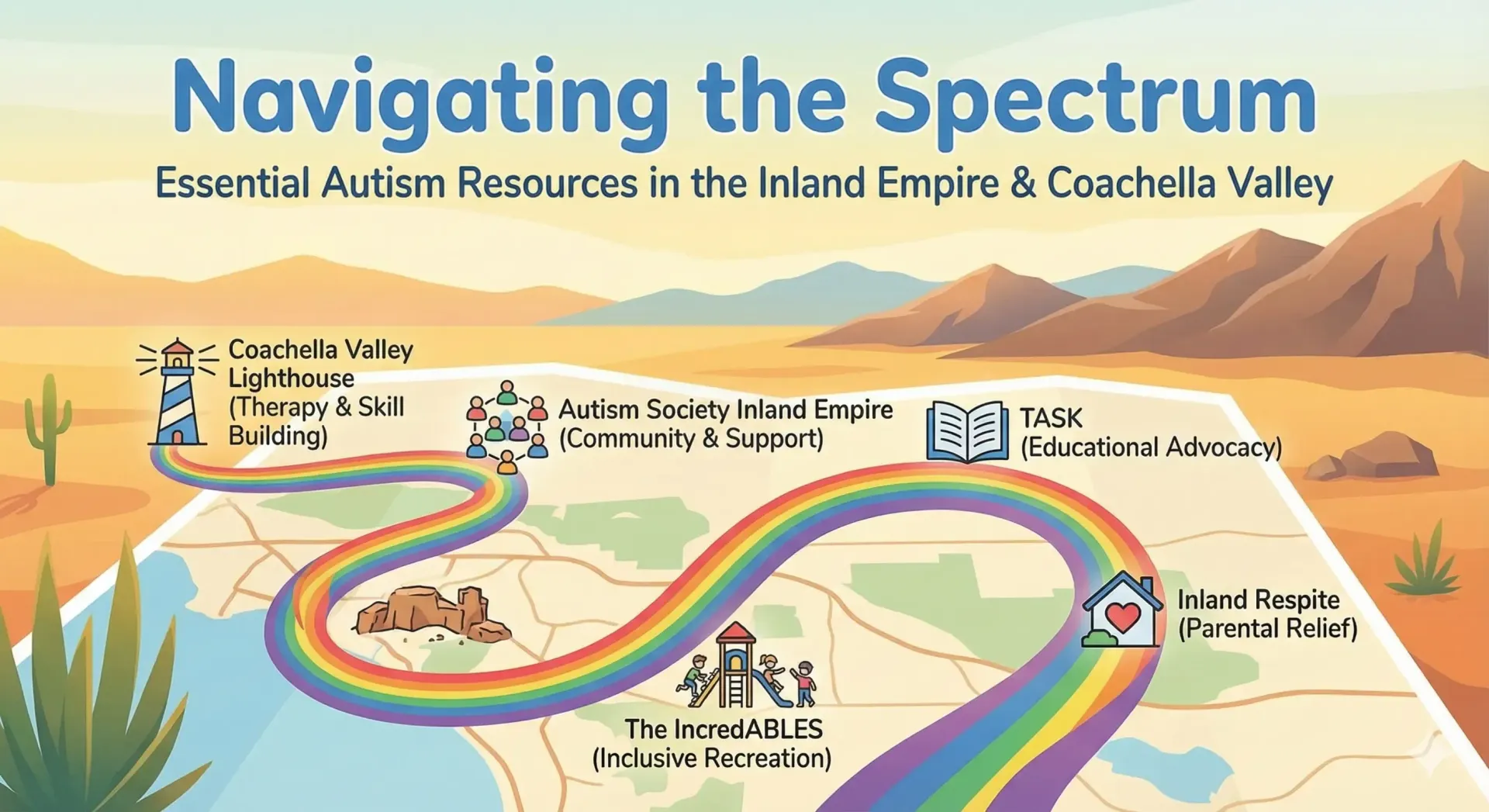
From foundational therapy to inclusive recreation and educational advocacy, here is a guide to the local organizations helping families thrive in Riverside and San Bernardino Counties. If you are raising a child on the autism spectrum in the sprawling Inland Empire, you know that "local" can mean anything from the high desert to the vineyards of Temecula or the heart of the Coachella Valley. The geography is vast, and navigating the maze of available services can sometimes feel overwhelming. Families often tell us they feel like they are reinventing the wheel, spending hours searching for trusted providers, accessible activities, or someone to help them understand an IEP. At Coachella Valley Lighthouse, we believe that thriving on the spectrum requires a holistic ecosystem of support. While therapy is often a crucial cornerstone, families also need community connection, strong advocacy in schools, and opportunities for pure fun. We have compiled a list of essential resources across the Inland Empire—including our own services—to help your family build that ecosystem. 1. Foundational Skill Building: Coachella Valley Lighthouse For many families following a diagnosis, the first priority is finding the right therapeutic partner to help their child develop communication, social, and adaptive skills. We are proud to be a leading resource in this area for families in the Coachella Valley and surrounding Inland Empire regions. At Coachella Valley Lighthouse , we specialize in Applied Behavior Analysis (ABA) therapy. But we don't believe in a one-size-fits-all approach. Our focus is on creating highly personalized programs that respect the individuality of your child. We work to build foundational skills—like functional communication and emotional regulation—that open doors to greater independence and participation in the community. Whether in your home, remotely, or in community settings, our goal is to be the guiding light on your family's unique journey. Learn more about our approach to ABA therapy on our homepage . 2. The Information Powerhouse: Autism Society Inland Empire (ASIE) If CV Lighthouse is your partner in skill-building, think of the Autism Society Inland Empire as your central intelligence hub for the entire region. ASIE is arguably the most comprehensive connector for families in Riverside and San Bernardino counties. They are essential for reducing the isolation many parents feel. Their "Resource Specialists" are real people you can call when you hit a brick wall trying to find services. Furthermore, their events, like "Talk to Me Tuesday" support groups, allow parents to swap tips on everything from sensory-friendly dentists to navigating insurance hurdles. Visit their resource library at ieautism.org . 3. Educational Advocacy: Team of Advocates for Special Kids (TASK) Once your child enters the school system, the IEP (Individualized Education Program) becomes a central part of your life. Navigating school districts and ensuring your child receives the accommodations they are federally entitled to can be incredibly stressful. You do not have to do it alone. TASK is a nonprofit Parent Training and Information Center that serves the IE. They provide workshops and information to help parents understand their rights under the Individuals with Disabilities Education Act (IDEA). Before you walk into a difficult IEP meeting, connect with TASK to ensure you are prepared to be your child’s best advocate. Find their Inland Empire resources at taskca.org . 4. Inclusive Recreation: The "IncredABLES" Program Therapy and school are vital, but kids also need to just be kids without pressure. Finding truly inclusive recreational activities, however, can be a challenge. The City of Rancho Cucamonga has set a gold standard in the IE with their "IncredABLES" program. They offer adaptive sports leagues, dances, Friday night social clubs, and camps designed specifically for individuals with special needs. It is a fantastic way for children and teens to practice social skills in a natural environment and, most importantly, make friends and have fun. Check out their current activity guide on the City of Rancho Cucamonga website . 5. Parental Respite: Inland Respite  Autism parenting is a marathon, not a sprint. Burnout is a very real challenge, and to take the best care of your child, you must take care of yourself. "Respite care" provides temporary relief for primary caregivers. Unlike typical babysitting, agencies like Inland Respite employ caregivers trained to support individuals with developmental disabilities. Utilizing respite allows parents time to recharge, run errands, or spend time with other siblings, knowing their child is in safe, capable hands. Note: Many families access respite funding through the Inland Regional Center (IRC). Learn more about their services at inlandrespite.com . Building Your Village The journey through the spectrum is unique for every family, but it should never be a lonely one. By combining skill-building therapies with strong community advocacy and inclusive recreation, we can create an environment where individuals with autism thrive. If you are looking for a partner to begin building foundational skills for your child, we are here to help. Contact Coachella Valley Lighthouse today to learn more about our services and how we can support your family.
aba therapy happening in center
By Stephanie Rosales November 23, 2025
Confused by autism therapy options? We compare ABA therapy vs. Speech, OT, and Floortime to help parents make the best choice. Learn why ABA is the gold standard.
aba therapy session
By Stephanie Rosales October 23, 2025
As parents, it’s natural to wonder whether your child needs ABA therapy. Let's discuss some signs that could indicate it's time to get ABA therapy.
aba therapy session
By Stephanie Rosales September 10, 2025
Learn what ABA therapy is, how it works, and the benefits for children with autism. CV Lighthouse offers compassionate, individualized ABA therapy to help families in Riverside, San Bernardino, and Imperial County.
RBT in Palm Springs providing ABA therapy.
By Stephanie Rosales August 10, 2025
Help your child adapt to change with proven ABA therapy techniques. Learn strategies like visual schedules, social stories, and positive reinforcement.
By Stephanie Rosales July 9, 2025
Understanding and reducing aggressive behavior in children with autism is possible with Applied Behavior Analysis (ABA). Learn how ABA's evidence-based strategies, from functional behavior assessment to teaching replacement behaviors, can help your child and family.
By Stephanie Rosales July 9, 2025
Discover why parent involvement in ABA therapy is critical for your child’s success. Learn how families can actively support autism treatment and long-term progress.
By Stephanie Rosales May 12, 2025
The body content of your post goes here. To edit this text, click on it and delete this default text and start typing your own or paste your own from a different source.
Discover how play-based ABA therapy transforms learning for children with ASD. CV Lighthouse uses fu
By Stephanie Rosales May 5, 2025
Discover how play-based ABA therapy transforms learning for children with ASD. CV Lighthouse uses fun, engaging activities to develop essential life skills. Contact us for a consultation!